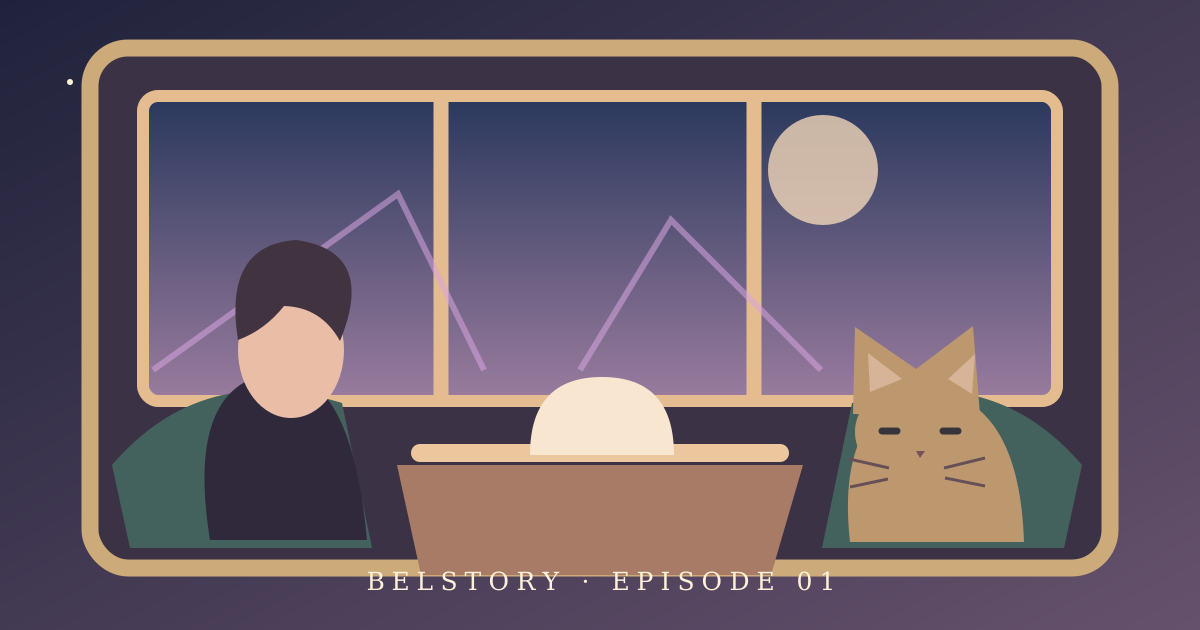
Belstory · Episode 01 · Life & Work
The Blueprint Thief
A story about stolen credit, the fear of speaking up, and learning to stand up for yourself.
A Belstory Original · Fiction · About 2,289 words
Explore chapters
1. The Presentation
Bel knew something was wrong as soon as the first slide appeared.
She was sitting near the end of a long conference table. Around her were managers and executives, all watching the large screen at the front of the room.
David stood beside it, smiling.
“Today, I'd like to introduce a new approach for running some of our AI tools,” he began. “It can reduce cloud costs, give users more control over their data and make the products more reliable.”
Bel sat up straighter.
She recognized the diagram on the screen. She had drawn it herself.
Then came the next slide. And the next.
The deployment architecture. The local storage plan. The diagrams showing how the different parts worked together. Even the order of the presentation was familiar.
This was the project she had worked on for three months.
Two days earlier, she had shared the documents with David. She had asked for his feedback on the schedule. Now he was presenting the work to the leadership team without mentioning her name.
“This is very impressive, David,” Robert, the Chief Technology Officer, said. “Especially the privacy approach.”
“Thank you,” David replied.
Bel wanted to raise her hand.
Actually, I developed that architecture.
It was only one sentence. It was true. But the thought of saying it made her heart race.
What if David denied it? What if the room went silent? What if everyone decided she was being difficult?
Bel looked down at her notebook.
She wrote three words: This is mine.
But she said nothing.
2. The Walk Home
After the meeting, people gathered around David. They asked questions and congratulated him. Bel closed her laptop and put it in her bag.
“Good meeting, right?” David said as she reached the door.
Bel looked at him. She waited for him to mention her part in the work.
“Looks like the executives are excited,” he added.
“Yes,” she said quietly. “They are.”
Outside, the evening streets were busy. Cars moved through traffic. People stood outside cafés. A vendor sold warm roasted almonds on the corner.
Bel usually enjoyed the walk home, but tonight she hardly noticed anything.
She kept replaying the meeting.
In one imagined version, she raised her hand and explained everything. In another, Robert asked her to take over the presentation. In a third, David admitted he had used her work.
None of those things had happened.
She felt angry with David. She was also angry with herself.
Why didn't I speak? she wondered.
By the time she reached her apartment, she had asked herself the same question a hundred times.
3. Viti's Important Business
Viti was waiting on the kitchen counter.
He was a large tabby with thick stripes, yellow eyes and a small nick in his left ear. He was also sitting exactly where he wasn't allowed to sit.
“Viti,” Bel said.
He blinked.
“Get down.”
He blinked again.
“Fine. You win.”
Viti jumped to the floor and followed her to the kitchen, meowing loudly.
“You wouldn't believe my day,” Bel said as she opened his food. “Someone took all the credit for my project.”
Viti rubbed against her leg.
“And I didn't say anything.”
He meowed once more.
“I appreciate your concern.”
She put down his bowl. Viti immediately started eating, entirely focused on his dinner.
Bel smiled despite herself.
“No meetings for you. No office politics. Just food and naps.”
She sat on the sofa and opened her laptop.
She drafted an email to Robert.
I would like to clarify that the architecture David presented today was originally developed by me.
She read it. Deleted it. Wrote a softer version. Deleted that too.
What would Robert think? Would David be angry? Would she make her situation worse?
An hour passed.
Viti jumped onto the sofa and walked across her keyboard. A row of nonsense letters appeared in the email.
“Viti!”
He settled beside her as though he had improved the document.
Bel laughed for the first time that evening.
But the email stayed unsent.
4. The Dream Train
Near midnight, Bel brushed her teeth and went to bed. Viti curled up near her feet. The city hummed softly beyond the window.
She closed her eyes.
She imagined David receiving a promotion. She imagined her work being forgotten. She imagined never finding the courage to speak up.
Gradually, the sound of traffic changed.
Clack. Clack. Clack.
Bel opened her eyes.
She was sitting inside a beautiful old train.
Green velvet chairs surrounded small tables covered with white cloths. Brass lamps glowed along the walls. Outside the windows, huge shapes of light floated in a star-filled sky.
“Where am I?” she whispered.
“That is a reasonable question,” said a voice across from her.
Bel turned.
A tabby cat sat upright in the chair opposite her. He had the same stripes, yellow eyes and nicked ear as Viti. In front of him stood a little bowl of cream.
Bel stared.
“Viti?”
“I certainly look like him.”
“You can talk!”
“Apparently.”
Bel glanced outside at a glowing glass tower drifting past the train.
“I'm dreaming.”
“That would explain the scenery.”
“Are you really my cat?”
“You know what your cat looks like,” he replied. “You know you're dreaming. The rest is harder to prove.”
Bel frowned.
“That's not much of an answer.”
“It's the answer I can give honestly.”
The cat took a sip of cream.
“Now,” he said, “tell me about David.”
5. What Bel Knows
Bel leaned forward.
“He stole my project. He stood there and took the credit while I sat in the corner.”
The cat listened without interrupting.
“Did you develop the work?” he asked.
“Yes.”
“Can you prove it?”
“Of course. I have the drafts, diagrams, test notes and emails. I even have the message where I sent the documents to David.”
“Good.”
“Good? I expected you to say something more dramatic.”
“Would you prefer drama or something useful?”
Bel sighed. “Useful.”
“Then let's separate what you know from what you're imagining. You know you developed the work. You know David presented it without crediting you. What don't you know?”
Bel thought.
“I don't know what Robert would say if I spoke up.”
“Exactly.”
“He might think I'm difficult.”
“He might. But he might also appreciate knowing who did the work. Neither result is certain.”
“Speaking up could hurt my career.”
“That is a possibility,” the cat said. “And in some workplaces, it is a real risk. But a risk isn't a prediction. You need to examine it rather than treat the worst outcome as inevitable.”
Bel looked through the window. A glowing circle drifted across the sky.
“I was scared,” she said.
“That doesn't mean you were weak. It means you faced something difficult. What matters now is what you do next.”
“I should have spoken in the meeting.”
“Perhaps. But we can't return to that meeting. We can only decide what to do tomorrow.”
6. The Architect and the Blueprint
The cat rested one paw on the table.
“Tell me about the architecture.”
Bel looked puzzled.
“Why?”
“Because I want to hear you explain it.”
She began slowly, describing how some tools could run directly on a user's device instead of depending entirely on cloud servers.
She talked about local storage, software updates and the work needed to test different devices.
“People sometimes assume local means automatically secure,” she said. “It doesn't. You still need careful storage design, updates, recovery plans and testing.”
The cat nodded.
“And did David create those plans?”
“No. I did.”
“Can you show the earlier versions?”
“Yes.”
“Then that's what matters. A slide can be copied. The process of developing it leaves evidence.”
Bel looked down at her hands.
“Maybe David doesn't even understand the technology.”
“Maybe he does, maybe he doesn't. You can't know that from the presentation alone.”
“He didn't design it.”
“That is an important distinction. But you don't need to prove he's incompetent to prove you contributed.”
Bel paused.
She had spent the evening thinking about how to embarrass David. She hadn't spent much time planning how to establish the facts.
“So I should show my work?”
“Yes. Show the work you actually did. Be precise about your contribution. Don't exaggerate, and don't guess about what someone else knows or intends.”
Bel smiled slightly.
“You don't give easy compliments, do you?”
“I've been told my fur is excellent. That's usually enough for me.”
7. A More Useful Plan
“What if they still don't give me credit?” Bel asked.
“I can't promise they will,” the cat replied.
“That's not reassuring.”
“Reassurance isn't useful if it's based on a promise no one can make.”
Bel considered that.
“What can I do, then?”
“First, keep the original records. Don't change them to make your case look stronger. Second, explain your contribution clearly and professionally. Third, ask for a role in the next stage that reflects the work you've done.”
“Should I accuse David?”
“You can describe what happened without pretending to know why it happened. If you later need to raise a formal concern, use the appropriate process and the evidence you have.”
Bel breathed out slowly.
“And if Robert ignores me?”
“Then you'll know something new about the situation. You can decide whether to speak to another manager or use the company's internal channels.”
The train began to slow.
The shining shapes outside became brighter.
“There's one question you haven't asked,” the cat said.
“What?”
“You keep asking what could happen if you speak up. What could happen if you stay silent?”
Bel looked away.
If she stayed silent, the company might continue to believe David had developed everything. Future decisions might happen without her. Nothing in the record would explain her contribution.
“I've been trying to find a way to act without any risk,” she admitted.
“That would be lovely,” the cat said. “I'd also like a world where cream never runs out.”
Bel laughed.
Then she asked, “Will they believe me?”
The cat paused.
“I don't know. But you have evidence, and you can give them a chance to see it. That is more than silence can do.”
The windows filled with white light.
“Remember, Bel,” the cat said as the train faded, “being professional doesn't require being invisible.”
8. The Morning After
Bel opened her eyes to soft morning sunlight.
For a moment, she could almost hear the train.
At the foot of the bed, Viti was attacking a sock. He grabbed it with his front paws and kicked it with his back feet.
Bel laughed.
“Good morning, wise little gentleman.”
Viti bit the sock.
He was clearly not interested in philosophy.
Bel got up, made coffee and opened her laptop.
The old email was still waiting.
This time, she didn't start with her fear. She started with the facts.
She found her original diagrams, dated drafts and messages. She checked which internal documents she could share. Then she wrote:
Hi Robert,
Following yesterday's presentation, I'd like to share some background on the architecture.
I developed the original deployment framework, including the local execution model, storage design and privacy considerations. I've attached earlier design documents for context.
I'd be happy to walk through the technical decisions and discuss the next phase in today's meeting. Given my work on the system, I'd also like to take an active role in leading its development.
Best, Bel
She read the email twice.
It wasn't angry. It wasn't apologetic. It was clear, and she could support every statement.
She clicked Send.
She was still nervous.
But nervous was different from powerless.
9. Ten O'Clock
Bel reached the follow-up meeting early.
She had prepared a document called Phase Two: Scaling and Security. It covered compatibility testing, safe updates, local data protection and how to recover if something went wrong.
David entered the room.
“Morning, Bel.”
“Good morning.”
He glanced at her screen.
“What's that?”
“The technical plan for the next phase,” Bel said. “I'd like to explain it today, since I developed the original architecture.”
David looked surprised, but he didn't argue.
A few minutes later, Robert arrived.
“Bel, I received your email,” he said. “Thank you for the background. Could you walk us through the design and the next steps?”
Bel felt her heart beat faster.
“Of course.”
She stood and opened her presentation.
This time, she explained her own work.
When Robert asked about an untested compatibility issue, she didn't pretend to know the answer.
“We need more testing before I can confirm that,” she said.
Robert nodded. “Fair enough.”
The meeting continued. No one made a dramatic announcement. David didn't confess. Bel didn't receive an instant promotion.
But something important changed.
The managers asked Bel technical questions. They wanted her to prepare the next review. Robert proposed a separate discussion to clarify project responsibilities and the history of the work.
The problem wasn't completely solved.
Still, Bel had made her contribution visible, with evidence to support it.
She no longer sat silently at the edge of the room.
10. An Ordinary Cat
That evening, Bel opened her apartment door to find Viti waiting.
“Hello,” she said.
He meowed.
“Would you like to hear about my day?”
He walked toward his food bowl.
“I'll take that as a no.”
After dinner, Bel sat by the window with a cup of tea. The city looked the same as always. Traffic moved. People hurried home. Someone laughed on the pavement below.
She didn't know exactly what would happen at work.
She still had difficult conversations ahead.
But she had stopped asking her imagination to predict every answer.
She had looked at the facts, prepared her evidence and taken a reasonable step.
Viti jumped beside her and curled into a warm striped ball.
Bel stroked his head.
“So,” she whispered, “was that really you on the train?”
Viti opened one eye.
Then he closed it.
Bel smiled.
“Thought so.”
A moment later, he began to purr.
And for once, Bel didn't need another answer.
Watch the story
Belstory is fiction. The characters, events and dream conversations are invented for storytelling and reflection.